Grow Younger, Live Longer

In a nutshell
The sleep environment is crucial for a good night’s rest. Here are four pillars for creating a sleep-promoting environment:
A good night’s rest can make all the difference in how you feel throughout your day, and it’s also essential for your mental and physical health. Good sleep is impossible without a good sleep environment – it is the foundation upon which other sleep habits build. That is why creating a good sleep-promoting environment in your bedroom is so important. In this article, we focus on how to improve your sleep environment by following four easy rules.
1. Temperature

The ideal sleep environment starts with the right temperature. Among all environmental cues, temperature plays a vital role in regulating sleep1Fan, Yaqian et al. “How Temperature Influences Sleep.” International journal of molecular sciences vol. 23, 20 12191. 13 Oct. 2022. PubMed Source Our bodies experience a slight dip (about 1°F) in core temperature in the evening and overnight. This physiological mechanism promotes and maintains sleep. [/mfn]
Turning the thermostat down at night and keeping your bedroom cool may help regulate your core temperature and signal your body that it’s time for bed. According to the USA’s National Sleep Foundation, the best bedroom temperature for sleep is approximately 65 °F (18.3° C).
Here are some tips on how to keep the temperature optimal in your bedroom:
- Use a Thermostat. If possible, use a thermostat to maintain a consistent temperature in your bedroom.
- Consider Your Bedding. Choose breathable fabrics like cotton for your sheets, and consider using a lighter or heavier blanket, depending on the season.
- Ventilation. Make sure your room is well-ventilated. A fan or an open window can help circulate air and maintain a cool temperature.
- Warm Bath or Shower. Taking a warm bath or shower before bed can also help. The drop in body temperature after the bath may help you feel sleepy.2 Raymann, Roy J E M et al. “Skin temperature and sleep-onset latency: changes with age and insomnia.” Physiology & behavior vol. 90,2-3 (2007): 257-66. PubMed Source
- Light Exercise. Engaging in light exercise 1.5-2 hours before bedtime can also help decrease your body temperature, promoting sleepiness.3 Stutz, Jan et al. “Effects of Evening Exercise on Sleep in Healthy Participants: A Systematic Review and Meta-Analysis.” Sports medicine (Auckland, N.Z.) vol. 49,2 (2019): 269-287. PubMed Source This could be as simple as a gentle yoga routine or a leisurely walk. Remember, though, that vigorous exercise too close to bedtime can have the opposite effect, making it harder to fall asleep.
2. Light

Natural light-dark conditions guide our circadian clock. During the day, sunlight triggers your brain to produce cortisol, which helps you stay alert and energized. So exposing yourself to the bright sunlight during the day is very important. At night when darkness falls, your brain produces another hormone, melatonin, to induce sleepiness and relaxation. Exposure to light, especially blue light, can suppress melatonin production. 4Burkhart, Kimberly, and James R Phelps. “Amber lenses to block blue light and improve sleep: a randomized trial.” Chronobiology international vol. 26,8 (2009): 1602-12. PubMed Source
Therefore, exposure to bright light (higher than 10 lux) in the late afternoon impairs sleep quality and delays sleep onset.5 Blume, Christine et al. “Effects of light on human circadian rhythms, sleep and mood.” Somnologie : Schlafforschung und Schlafmedizin = Somnology : sleep research and sleep medicine vol. 23,3 (2019): 147-156. PubMed Source That is why it is essential to follow the natural light pattern that has evolved over thousands of years of evolution.
Here are a few ways how you can achieve a sleep-promoting dark environment in your bedroom:
- Use Dim Lights in the Evening. As bedtime approaches, approximately 2 hours before bed, dim the lights in your home to signal to your body that it’s time to sleep.
- Limit Screen Time Before Bed. Electronic devices like smartphones, tablets, and computers emit large amounts of blue light. Try to turn off these devices at least an hour before bedtime.
- Consider Light-Blocking Curtains or Eye Masks. These can be helpful if you live in an area with significant outdoor lighting at night, or if your schedule requires you to sleep during daylight hours.
- Get a Red or Orange Reading Lamp: If you enjoy reading before bed, consider using a red or orange lamp. Unlike regular lamps, these do not emit blue light, which can interfere with your sleep. The red or orange light can help you wind down without suppressing your melatonin production.6 Burkhart K, Phelps JR. Amber lenses to block blue light and improve sleep: a randomized trial. Chronobiol Int. 2009 Dec;26(8):1602-12. doi: 10.3109/07420520903523719. PMID: 20030543.PubMed Source
- Choose Darker Wall Colors for the Bedroom. The color of your bedroom walls can also affect your sleep quality. Darker colors can help create a serene and calming environment conducive to sleep. They can also reduce the amount of light reflected around the room, particularly if you live in an area with significant night-time lighting.
- Use a Wake-Up Light. A wake-up light can help you wake up naturally by gradually increasing the light in your room, simulating a sunrise.
- Get Plenty of Natural Light During the Day. Exposure to natural light during the day can help regulate your sleep-wake cycle. Try to spend some time outside each day, or let natural light into your home or office.
3. Noise
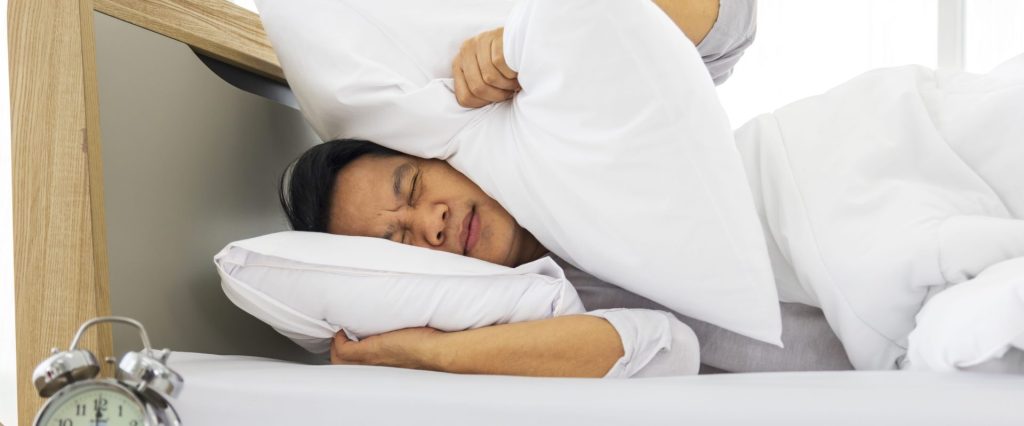
The sounds in your environment can significantly influence the quality of your sleep, thus potentially impacting your well-being. It’s not just about volume—consistency and the nature of the sounds also matter.
Even when you’re asleep, your brain continues to register and process sounds on a basic level. Sudden, loud noises can cause you to move, wake, shift between stages of sleep, or even momentarily increase your heart rate and blood pressure.7 Hume KI, Brink M, Basner M. Effects of environmental noise on sleep. Noise Health. 2012 Nov-Dec;14(61):297-302. doi: 10.4103/1463-1741.104897. PMID: 23257581. PubMed Source
The quieter your bedroom is, the better it is for your sleep. Loud noise can cause severe sleep fragmentation and shifts to lighter sleep stages overnight. The WHO recommends having ambient noise not higher than 30 dB for good-quality sleep.8 Smith, Michael G et al. “Environmental Noise and Effects on Sleep: An Update to the WHO Systematic Review and Meta-Analysis.” Environmental health perspectives vol. 130,7 (2022): 76001. PubMed Source
Here are some tips on how to achieve a silent bedroom:
- Soundproofing. If possible, try to soundproof your room. This could include using heavy curtains, installing double-glazed windows, or adding extra insulation.
- Earplugs. If you cannot control the noise in your environment, consider using earplugs. They can significantly reduce noise levels and help you sleep better.
- White Noise. White noise machines can also be useful. They produce a consistent sound that can help to mask background noises. There’s evidence that listening to white noise can improve sleep quality.9 Spencer JA, Moran DJ, Lee A, Talbert D. White noise and sleep induction. Arch Dis Child. 1990 Jan;65(1):135-7. doi: 10.1136/adc.65.1.135. PMID: 2405784; PMCID: PMC1792397. PubMed Source
- Soundscape. Some people find that gentle, consistent sounds like rain, waves, or wind help them fall asleep and stay asleep. There are many apps and devices available that can provide these kinds of soundscapes.
4. Comfortable bedding

Comfort is key when it comes to promoting good sleep, and a significant part of that comfort comes from your bed and bedding. The quality of your mattress, pillows, and sheets can all impact how well you sleep, which can, in turn, affect your health and longevity.
1. Choosing the Right Mattress
The mattress you sleep on can significantly affect your sleep quality. A comfortable and supportive mattress can help ensure proper alignment of the spine, reducing the risk of waking up with aches and pains.10 Jacobson BH, Boolani A, Dunklee G, Shepardson A, Acharya H. Effect of prescribed sleep surfaces on back pain and sleep quality in patients diagnosed with low back and shoulder pain. Appl Ergon. 2010 Dec;42(1):91-7. doi: 10.1016/j.apergo.2010.05.004. Epub 2010 Jun 26. PMID: 20579971. PubMed Source A mattress should be replaced every 7-10 years, but this can depend on the quality and type of mattress, as well as individual comfort.
Nowadays, a huge variety of mattresses can satisfy different needs depending on your preferred sleeping positions, if you are a hot or cold sleeper. Revising this issue and finding out what mattress is best for you can drastically improve your sleep. Some studies have found that newer mattress systems promote better sleep quality.11 Jacobson, Bert H et al. “Changes in back pain, sleep quality, and perceived stress after introduction of new bedding systems.” Journal of chiropractic medicine vol. 8,1 (2009): 1-8. PubMed Source
2. Selecting the Perfect Pillow
Your pillow plays a critical role in maintaining the alignment of your neck and spine during sleep. A pillow that is too high or too low can lead to neck pain and poor sleep. The right pillow for you largely depends on your sleeping position – side sleepers typically need a thicker pillow, while back and stomach sleepers need thinner ones.12Gordon SJ, Grimmer-Somers K, Trott P. Pillow use: the behaviour of cervical pain, sleep quality and pillow comfort in side sleepers. Man Ther. 2009 Dec;14(6):671-8. doi: 10.1016/j.math.2009.02.006. Epub 2009 May 7. PMID: 19427257. PubMed Source
3. Investing in Quality Sheets and Bedding
Sheets and bedding come into direct contact with your skin and can significantly affect your comfort and temperature regulation during sleep. Breathable fabrics like cotton can help prevent overheating during sleep, while warmer materials like flannel can be beneficial in colder climates.13 Özdemir, Hakan. “Thermal Comfort Properties of Clothing Fabrics Woven with Polyester/Cotton Blend Yarns.” Autex Research Journal 17 (2017): 135 – 141. Source
By investing in a comfortable and supportive mattress, the right pillow, and quality bedding, you can create a sleep environment that enhances your sleep quality and contributes to your overall health and longevity.
Recap and final thoughts
Following these simple rules will help you to achieve a perfect sleep environment for good-quality sleep. Remember that having a wind-down evening routine and good sleep habits is similarly important. To learn more about good sleep hygiene, please visit our guide on Sleep Habits and Routines.
References
- 1Fan, Yaqian et al. “How Temperature Influences Sleep.” International journal of molecular sciences vol. 23, 20 12191. 13 Oct. 2022. PubMed Source ↩︎
- 2Raymann, Roy J E M et al. “Skin temperature and sleep-onset latency: changes with age and insomnia.” Physiology & behavior vol. 90,2-3 (2007): 257-66. PubMed Source ↩︎
- 3Stutz, Jan et al. “Effects of Evening Exercise on Sleep in Healthy Participants: A Systematic Review and Meta-Analysis.” Sports medicine (Auckland, N.Z.) vol. 49,2 (2019): 269-287. PubMed Source ↩︎
- 4Burkhart, Kimberly, and James R Phelps. “Amber lenses to block blue light and improve sleep: a randomized trial.” Chronobiology international vol. 26,8 (2009): 1602-12. PubMed Source ↩︎
- 5Blume, Christine et al. “Effects of light on human circadian rhythms, sleep and mood.” Somnologie : Schlafforschung und Schlafmedizin = Somnology : sleep research and sleep medicine vol. 23,3 (2019): 147-156. PubMed Source ↩︎
- 6Burkhart K, Phelps JR. Amber lenses to block blue light and improve sleep: a randomized trial. Chronobiol Int. 2009 Dec;26(8):1602-12. doi: 10.3109/07420520903523719. PMID: 20030543.PubMed Source ↩︎
- 7Hume KI, Brink M, Basner M. Effects of environmental noise on sleep. Noise Health. 2012 Nov-Dec;14(61):297-302. doi: 10.4103/1463-1741.104897. PMID: 23257581. PubMed Source ↩︎
- 8Smith, Michael G et al. “Environmental Noise and Effects on Sleep: An Update to the WHO Systematic Review and Meta-Analysis.” Environmental health perspectives vol. 130,7 (2022): 76001. PubMed Source ↩︎
- 9Spencer JA, Moran DJ, Lee A, Talbert D. White noise and sleep induction. Arch Dis Child. 1990 Jan;65(1):135-7. doi: 10.1136/adc.65.1.135. PMID: 2405784; PMCID: PMC1792397. PubMed Source ↩︎
- 10Jacobson BH, Boolani A, Dunklee G, Shepardson A, Acharya H. Effect of prescribed sleep surfaces on back pain and sleep quality in patients diagnosed with low back and shoulder pain. Appl Ergon. 2010 Dec;42(1):91-7. doi: 10.1016/j.apergo.2010.05.004. Epub 2010 Jun 26. PMID: 20579971. PubMed Source ↩︎
- 11Jacobson, Bert H et al. “Changes in back pain, sleep quality, and perceived stress after introduction of new bedding systems.” Journal of chiropractic medicine vol. 8,1 (2009): 1-8. PubMed Source ↩︎
- 12Gordon SJ, Grimmer-Somers K, Trott P. Pillow use: the behaviour of cervical pain, sleep quality and pillow comfort in side sleepers. Man Ther. 2009 Dec;14(6):671-8. doi: 10.1016/j.math.2009.02.006. Epub 2009 May 7. PMID: 19427257. PubMed Source ↩︎
- 13